
Manufacturing of metal parts should be considered since the design stage, as constraints due to process, quantities and quality may vary from one manufacturing process to another.
The objective of this article is to offer a simplified presentation of different processes in order to give a glimpse of possibilities and characteristics of different methods used in manufacturing metal parts.
| Process | Advantages | Disadvantages | Costs |
|---|---|---|---|
| Machining | -Flexible -Allows a good surface aspect -Little risk of material defect -Available for all materials | -Some complex shapes are difficult to achieve
– Relatively slow – Lot of waste is created | Average |
| Casting | -Allows some complex shapes
-Reproducibility of parts | – Shape constraints for un-moulding
-Not all materials are available | -Low for large series -High tooling costs |
| Extrusion | -High productivity
– Good material quality | -Very limited shape types
-Limitation of available materials | Low |
| Forging | -Very good material quality
-High production rates | -Limited shape types | Parts cost is low in large quantities |
| Additive manufacturing | – No material waste
– Manufacturing of very complex shapes -Possible for the production of single parts | -Slow
-Not many available materials | High cost per part, but does not require tooling costs |
Machining
Machining of metal parts requires the purchase of raw material in bulk and the use of different cutting tools mounted on a machine.
The metal part will be made by removing metal chips, which leads to a certain quantity of material waste.
Machining center
A machining center is the basic manufacturing device for machining a metal part. Material is removed from a part fixed to the machine frame by a cutting tool rotated at high speed and positioned with precision by an articulated arm.
There are many types of machining centers, most are numerically controlled (hence the name CNC Center) and can have very different sizes depending on the parts to be produced. The complexity of the parts that can be produced on a machining center depends on the number of axes of rotation of the machines, we often speak of 3-axis, 4-axis, 5-axis centers, the higher the number of axes, the more the tools can make complex shapes.
In general, machining centers can work most materials (aluminum, steels, plastics) depending on the cutting tools used. It is nevertheless more interesting to specialize them in order to better use its tools and avoid chips contamination which would become more difficult to recycle.
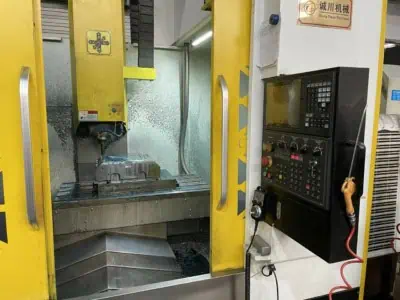
Numerical machining center
Lathe
Lathes are used to machine parts with rotational symmetry. In conventional turning, the workpiece rotates at high speed while the cutting tool remains fixed in the tool holder. The tool is brought into contact with the rotating workpiece and moves along or across it to remove material and produce the required shape.
For example pistons are usually made on lathes.
CNC automatic lathe
A CNC automatic lathe is a machine specialized in the production of small parts of revolution in large quantities, they are automatically loaded, rods of metallic materials being directly loaded into the machine, machined and cut. Most high volumes threaded rods are made this way.
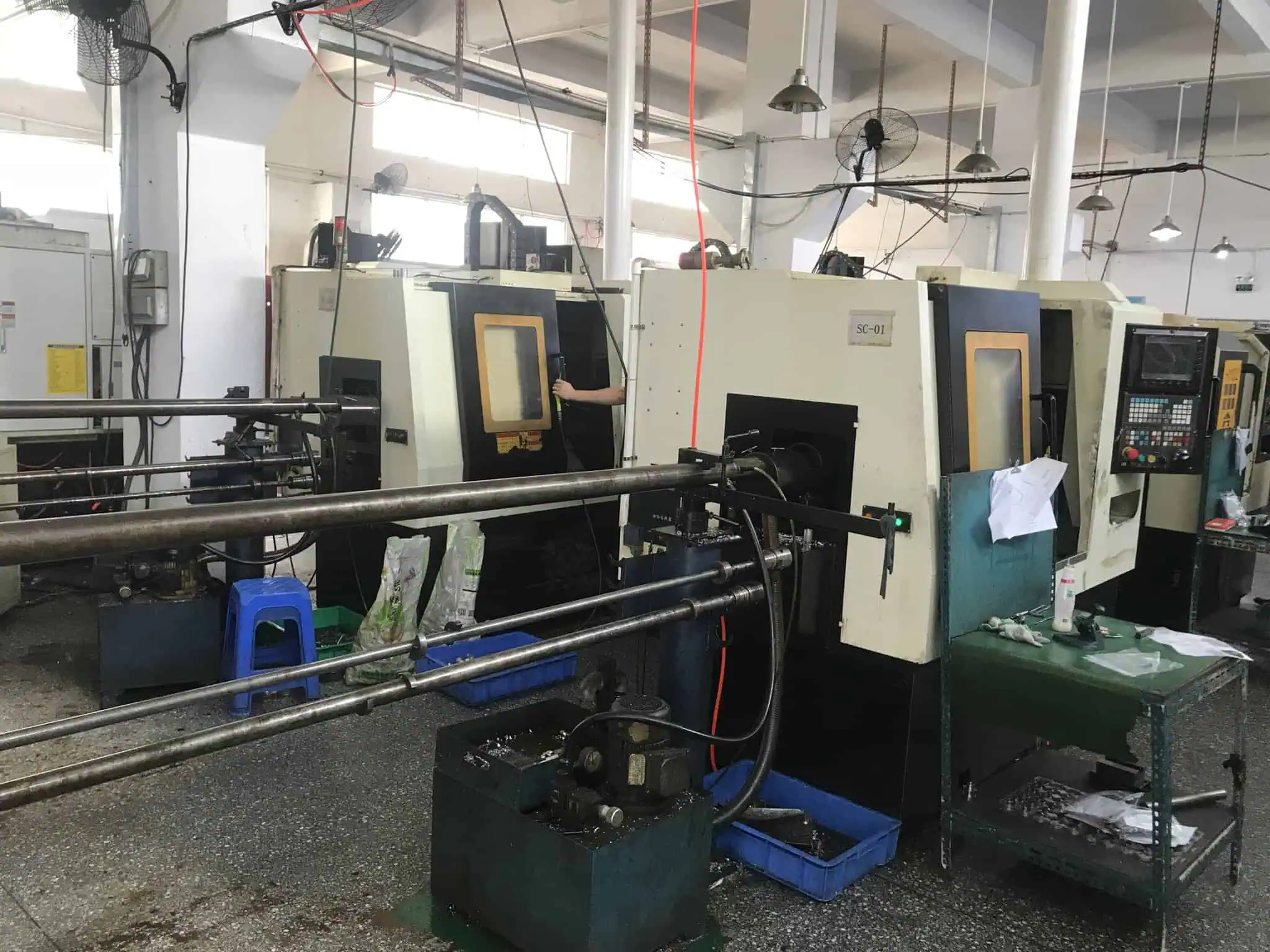
CNC automatic lathe
Casting
Casting process involve heating a metal until it become molten and pouring it into a mould cavity that reproduce the desired shape of the finished part. There are different types of foundry offering particular characteristics:
Gravity casting
This is the oldest type of foundry and can be done for all metallic materials. Casting can be done in a metal mould (shell casting) or via a sand/silica mould (sand casting, lost wax casting).
Gravity casting is a very inexpensive manufacturing method, requiring low investment in tooling and ideal for medium series. However, the appearance quality of the parts is poor and shrink marks may also be present in the sand casting process.
High-pressure Die casting
High pressure die casting has been developed with the needs of the automotive industry, it allows, thanks to the pressurization of the molten metal, to achieve very fast manufacturing rates and very low wall thicknesses. This process is mainly used for aluminium and ZAMAK. The price of the moulds is very high, but for large series it can be compensated by a very competitive unit price.
Sheet metal manufacturing
Production of sheet metal parts corresponds to the manufacture of a part from metal sheet materials. These sheets, of all materials, can be transformed using different processes:
Bending-cutting
The first step in sheet metal work is often the cutting of the sheet into a pre-cut blank which will facilitate its bending.
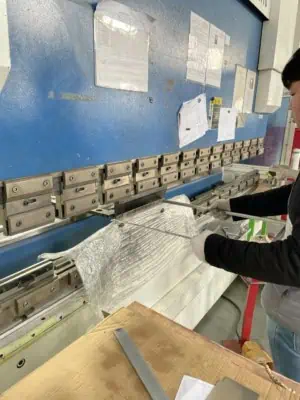
bending press
Punching
Sheet metal punching is a solution for cutting material and making holes by removing chunks of material.
Laser / water jet cutting
Laser cutting is a process still under improving and allows complex sheet metal cuts to be made quickly with good uniformity in the quality of the cut edges.
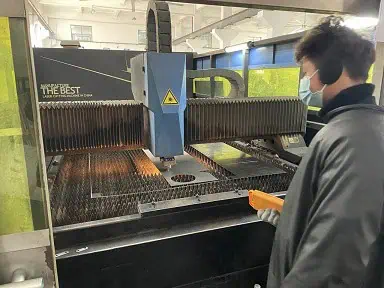
Laser cutting machine
Welding sheet-metal assemblies
Folded or unfolded sheets can be assembled together or with other metal elements using welding, which permits the manufacture of very strong structures.
Extrusion
Extrusion is a process widely spread for the light metals (mainly aluminum) and allows the production of parts corresponding to a 3D projection of 2D pattern. An aluminum cylinder is pressed against an extrusion die, matching the cross-sectional profile shape. The material takes the shape of the die as it is forced through.
The shape of the extruded parts is entirely dependent on the shape of the tooling. The rectilinear parts thus manufactured can then be cut into different lengths and be otherwise worked (machined, drilled).
Forging
Metal forging is a manufacturing process in which heated metal billets are shaped under compressive force using a hammer or a forging press and die. The metal parts made in forging may be on any size and are generally appreciated for their high mechanical resistance, particularly in relation to foundry and machining.
Forged parts are widely used for all safety parts: carabiners, connectors, clips, etc.
There are mainly two types of forging:
Cold forging
In cold forging the raw material blocks are struck at room temperature. This process is mainly used for relatively flexible metals (Aluminium, copper, etc.). Cold stamping will harden the parts thus produced, this process requires more force than hot stamping but produces parts with less tight dimensional tolerances.
Hot forging
Preferred process in particular for steel, the material is preheated (around 1000°C for steel) before being struck either with a drop hammer or with a die from which the material will take the shape.
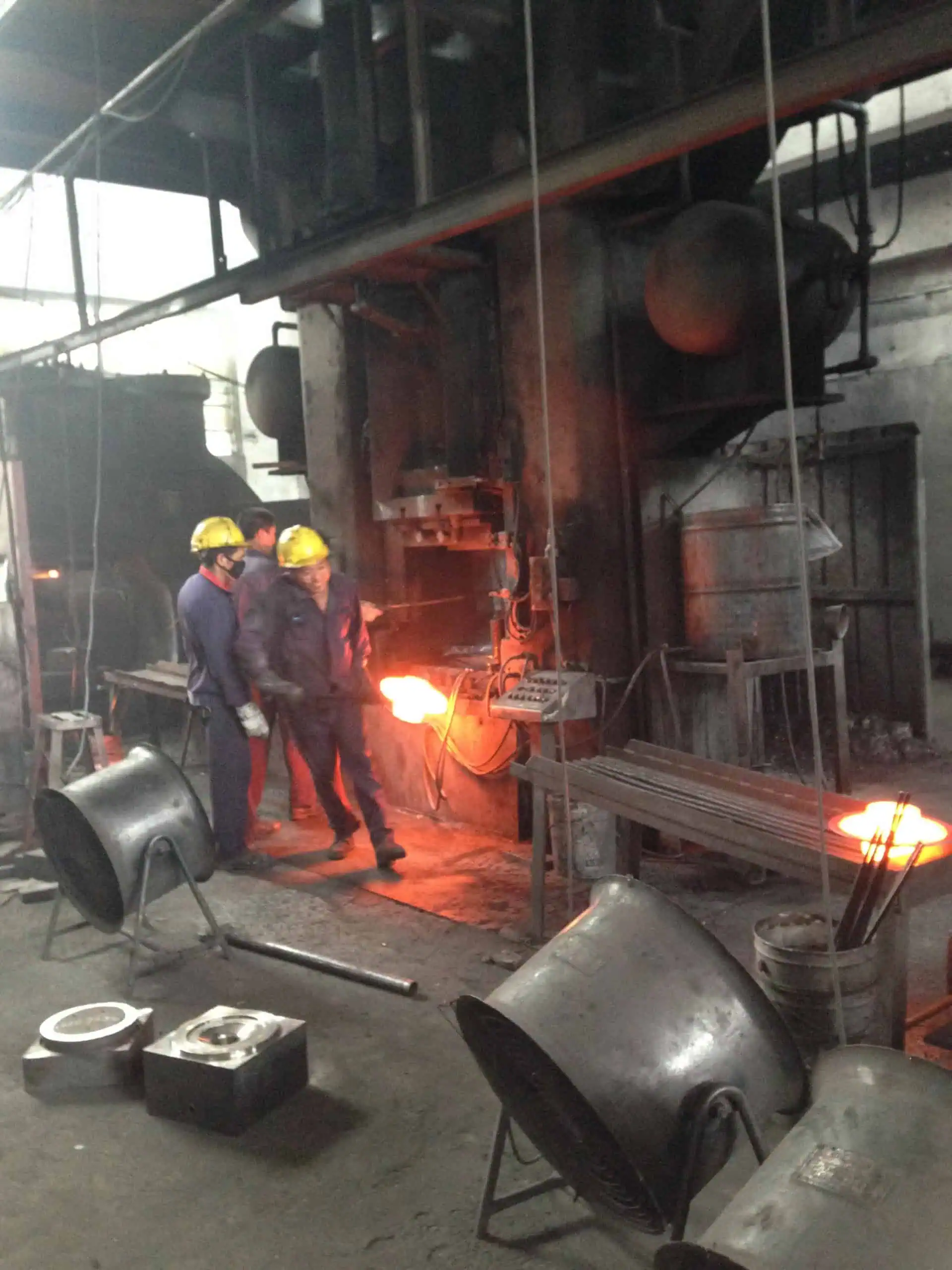
Hot forging
Metal 3D printing
More correctly called additive manufacturing, it is the most modern process for manufacturing metal parts, with the first industrial metal parts made in 3D being released at the beginning of the 21st century.
The process of additive manufacturing, well known for polymers, is also increasingly used for metals, allowing the production of complex parts, comprising closed recesses or elaborate structures of all sizes.
Manufacturing only requires a 3D printer and a digital model of the parts to be made. The parts will be made level by level, by localized addition of laser/plasma melted metal powder. Additional operation may be added like thermal treatment, machining and finishing, but these operations will necessitate specific industrial devices.
Additive manufacturing can be opposed to machining which is carried out by removing material and therefore produces much more waste.
The quality of metal parts made by additive manufacturing has improved a lot in recent years, especially on the surface aspect where the manufacturing grain is no longer discernible to the naked eye. The main drawback of additive manufacturing for metal is its slowness of production, which limits this process to small or medium series and is not competitive for relatively simple parts.


