
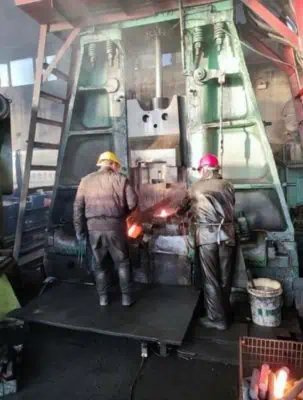
Forging press
When it comes to cheap strong metal parts in big quantities, forging process is often preferred. Forging consists of shaping a metal part by applying force to it. In below article we are going to introduce forging manufacturing in China.
Forging in China
There is more than 5000 forging companies in China, in 2020, China exported for $6.4 billion iron & steel forged parts which makes it the biggest forging manufacturing country. Application are wide, ranging from construction, automotive and railway to aerospace industries. Following the quick expansion of railways in China in the last 30 years, many forging companies have gained extensive experience in producing rails, rail screws, bolts, clips and spikes.

Forging Chinese factory
Many of the Chinese forging suppliers are low tech high labor companies of medium sizes. As the working conditions are not very pleasant workers are mainly old unqualified workers who cannot find better working positions. That is the reason why it is important for customers to closely follow the production in the factory.
One of the big advantage of making forged parts in China given it’s strong production base, is the ability to quickly scale production to meet demand.
Presentation of a typical Chinese forge
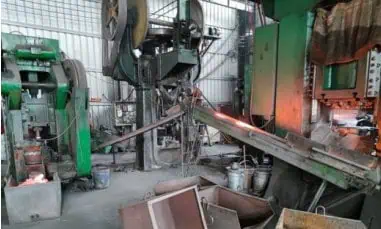
This forge located in the northern part of China have around 100 employees, mostly workers for the production, with few quality, logistic, design and support employees.
Raw material is bought from outside and is delivered in metal bars which are cut in preforms and heat in the furnace to reach their forging temperature (usually they are becoming orange/red color).
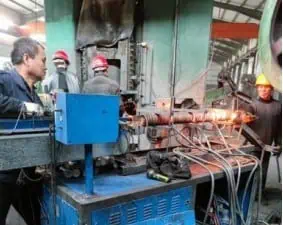
The blank is then entered into the press where they will get their final shape by action of the forging press rated at several hundred tonnes.
Part is then removed from the press, and cooled by air.
Once the part is cooled, further operations can be conducted, deburring, shot blasting, drilling or machining, heat treatment or surface treatment (for instance painting).
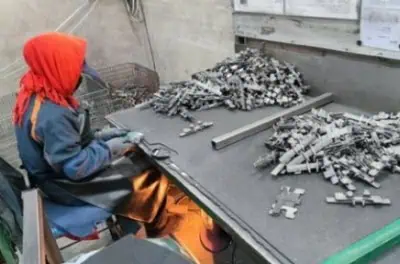
Forged parts & quality control
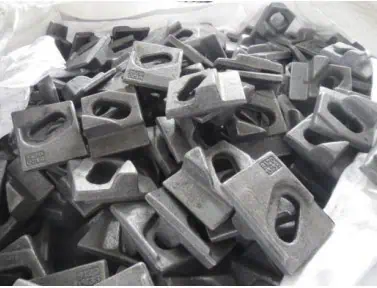
Forged parts are renowned for their robustness and therefore are used for critical structural applications (rivets, rails etc.) therefore following the quality of the part is very important. Outside of dimensional test, several test on the material should be conducted :
- Metallography by microscope
- Raw material tensile strength
- Salt spray test
As forging is a process mainly used for high quantities parts, packaging can be made in bulk and parts are often shipped out in batches.
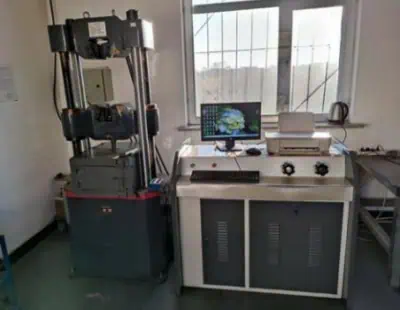
Material testing


