3D printing in a few words
Which 3D printing technologies are available ?
Depending on the part geometry, required quantity, material and surface finish, we can select the most appropriate 3D printing technology.
- SLA printing uses liquid photopolymer resin and provides a smooth surface finish and good detail. It is suitable for visual prototypes, small and intricate parts, transparent or translucent components, and models requiring a high level of accuracy.
- FDM printing produces parts by depositing thermoplastic filament layer by layer. It is a cost-effective solution for larger prototypes, functional testing and simple plastic parts. Common materials include PLA, ABS, PETG, nylon and other engineering thermoplastics.
- SLS printing uses a laser to selectively sinter polymer powder. It does not require conventional support structures and is suitable for complex geometries, functional prototypes and small series. Polyamide materials such as PA12 are commonly used.
The most appropriate technology depends on the dimensional requirements, mechanical properties, appearance, quantity and intended use of the part.
Which materials can be used?
We can provide prototypes in a range of plastics, including PLA, ABS, PETG, nylon, polycarbonate, TPU and photopolymer resins. The available materials offer different combinations of rigidity, flexibility, impact resistance, temperature resistance and surface appearance.
For example, PLA is suitable for economical visual prototypes, while ABS and PETG are more appropriate for functional parts requiring improved toughness. Nylon is often selected for strong and slightly flexible components. TPU can be used when elasticity or impact resistance is required. Resin materials are suitable for detailed parts and smooth surfaces.
Material selection should be based on the intended use of the prototype. A material suitable for checking assembly may not be appropriate for long-term outdoor use, high-temperature applications or continuous mechanical loading.
What are the tolerances that can be reached with 3D printing ?
Tolerances of approximately ±0.3 mm can typically be achieved, depending on the printing technology, material and part geometry. Tolerances can be improved by machining critical dimensions.
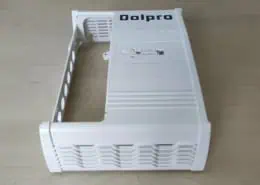
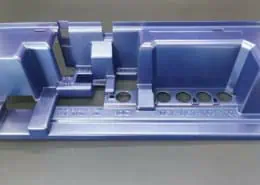
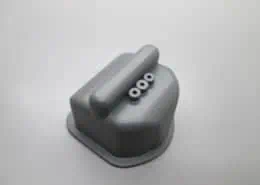
References of 3D printing parts done by AGC Industrial Solutions:
![[:de]transparent plastic parts prototype[:]](https://agcis.com/wp-content/uploads/2019/08/3D-printing-lenses-241x179.webp)
3D printing Lens
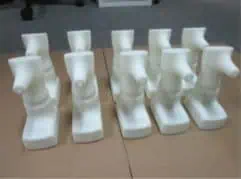
3D printing white ABS
Advantages and limitations of 3D printing plastic parts
What are the advantages of 3D printing plastic prototypes?
3D printing is particularly suitable when a part design needs to be validated before investing in injection moulds or other production tooling. It allows engineers to check the shape, dimensions, assembly and general appearance of a component at an early stage of product development.
Compared with conventional manufacturing methods, 3D printing requires little or no tooling. This reduces initial investment and makes it economical for prototypes, one-off parts and small batches. Design changes can also be implemented quickly because a new part can be produced directly from the modified 3D file.
3D printing is suitable for functional prototypes, fit-and-assembly checks, visual models, enclosures, covers, brackets, housings and many other plastic components. It can also be used to manufacture replacement parts or low-volume components when injection moulding would not be economically viable.
What are the limitations of 3D printing?
3D printing is not always the best solution for series production. The surface may show visible layer lines, depending on the printing technology and part orientation. Some materials may also be sensitive to ultraviolet radiation, moisture or elevated temperatures.
Dimensional accuracy depends on the printer, material, geometry, orientation and post-processing. Small features, holes and mating surfaces may require additional machining or finishing. Parts produced by different technologies may also have different mechanical properties and surface finishes.
For these reasons, we recommend confirming the critical dimensions, tolerances, material requirements and intended application before production.
Request a quote for you 3D-printed plastic part
Do you need small batches of plastic prototypes quickly? AGC Industrial Solutions offers a reliable, fast and cost-effective 3D printing prototyping service. Contact us to discuss your requirements.