
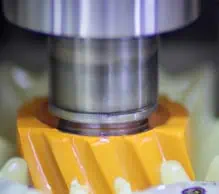
Plastic machining refers to the process of cutting, drilling, and shaping plastic materials using specialized tools and machines. Plastic machining is similar to conventional metal machining, but the process constraints differ because of the specific properties of polymers.
Plastic machining vs metal machining
Compared to machining metals, plastic machining has some unique characteristics and challenges. Here are some of the key considerations when machining plastics:
Low melting point
Plastic materials have a lower melting point than metals, moreover their heat conduction characteristics are much lower and therefore heat created by the cutting tool will not dissipate naturally. It means that plastic parts can easily be damaged by excessive heat during machining. This can cause the material to deform or even melt, resulting in a poor-quality finish.
To prevent this, it is important to use cutting tools with sharp edges and low cutting speeds. Low-cutting speeds downside is that parts manufacturing takes longer, which have an impact on productivity and therefore on part cost.
Softer than metals
Plastic materials are also softer and more brittle than metals, which means that they are more susceptible to chipping and breaking during machining. This can be mitigated by using tools with a positive cutting angle, which helps to distribute the cutting forces more evenly.
As polymers are softer than metals, cutting tools need to be changed less often, and are also cheaper as they don’t need to get through expensive hardening.
Specific mechanical properties
Plastics also have different mechanical properties than metals, which can affect the machining process. For example, some plastics are very rigid and strong, while others are flexible and elastic. This means that different cutting strategies may be required depending on the type of plastic being machined.
The general lower stiffness of plastics vs metals makes it more difficult to reach low machining tolerances. Maximum plastic machining tolerances that can be reached are around 0.02 mm.
Chemical sensitivity
Plastics can also be sensitive to certain chemicals and solvents, which can affect the machining process. For example, some plastics may become brittle or soften when exposed to certain solvents or even to water/humidity, necessary for the cooling of the parts during machining, which can make them more difficult to machine.
Machining of plastic, an alternative to plastic injection moulding
The machining of plastic process is very different from plastic injection moulding, as machining will be done on raw plastic blocks, while plastic injection moulding raw material is pellets that will be heated to become liquid and injected by press into molds.
Quantities ?
The big interest of plastic injection moulding, is its very low marginal cost for injection of parts. Most of it’s costs comes from the expensive tooling making and trimming of injection machine parameters at the start of the process.
Plastic machining marginal cost is roughly similar to the starting costs, furthermore as the process is rather slow it not so very interesting for high quantities orders (starting from thousands of parts).
Range of material limitations
Whereas most of the plastics can be injected, not all the plastic can be machined accurately. Often polymers that are too soft cannot be worked by machining, preferred plastics for machining are :
- PEEK
- POM (Delrin)
- Reinforced Nylon (PA)
- High-Density Polyethylene (HDPE)
- ABS
- PMMA (Acrylic)
- PC
Lead time
As no tooling is necessary for machining polymer parts, lead times are shorter than plastic injection moulding for first order. It is therefore interesting for prototyping, especially if the shape cannot be made by 3D printing.
Shape limitations
For very complex and container-type shapes, plastic injection moulding will be preferred to machining as it will get much quicker manufacturing time and much lower material waste. But plastic machining has a net advantage when it comes to wall thickness. Thick or uneven wall thickness are not easy to inject as it would impact material flow, but is not a limitation for machining.
Waste management
Machining a material is basically removing material with a cutting tool, therefore it creates wastes. Plastic machining waste can be recycled, but contrary to injection where wastes that can be reused in the injection process, machining chips cannot be reused for machining.


